Which water filter should you choose? A comparison of tap water solutions

Filter jug, tap-mounted filter, under-sink filter, reverse osmosis system or gravity-fed system: no solution is ideal in every situation. The right choice depends on the water being treated, the contaminants targeted and your practical requirements.

This guide compares these systems according to their installation, operation, maintenance, effects on water and, above all, the supporting evidence available.

The aim is not to name one universal winner, but to help you determine which water filtration system best suits your needs.

5 systems compared Filter jug, tap-mounted filter, under-sink, reverse osmosis and gravity
Everyday use Installation, flow rate, maintenance and independent operation
Effects on water Minerals, targeted contaminants and wastewater
Evidence to check Test reports, standards and certifications

Quick answer

Which water filtration system should you choose at a glance?

For filtering small quantities and mainly improving the taste or smell of chlorine: a filter jug or tap-mounted filter may be suitable.

For filtered water directly from the tap, without an appliance on the worktop: consider an under-sink filter.

For reducing a wide range of dissolved substances: reverse osmosis may be considered, taking into account the installation, wastewater produced and its effect on mineral content.

To combine the reduction of numerous contaminants, household capacity and independent operation: a gravity-fed system equipped with cartridges whose performance is documented offers a particularly comprehensive solution, requiring no plumbing connection or electricity and producing no wastewater during filtration.

If your main concern is limescale throughout the home: a water softener serves a different purpose. It does not replace a filter designed to reduce micropollutants in drinking water.

Key point: these indications describe the typical uses of each system. Actual effectiveness always depends on the product selected, the substances targeted and the available test results.

First criterion

Before choosing a water filter, identify what you need to treat

A filter is only relevant if it addresses a specific objective. Before comparing systems, distinguish between an issue related to taste, an identified substance, water hardness and a microbiological risk.

01 · COMFORT

Chlorine taste or smell

If your water is safe to drink but has an unpleasant taste or smell, your objective is mainly sensory. Certain filter media, particularly activated carbon, may reduce chlorine depending on their design and performance.

An improvement in taste does not, however, demonstrate that other contaminants have been reduced.

02 · TARGET CONTAMINANT

A specific pollutant or substance

Lead, PFAS, pesticides, nitrates and pharmaceutical residues do not necessarily require the same treatment. First identify the substance concerned, then check that the selected product publishes results specifically covering it.

A general claim such as “removes impurities” is not sufficient evidence.

03 · HARDNESS

Limescale and water hardness

Water hardness is mainly related to the calcium and magnesium present in water. A water filter does not therefore necessarily reduce hardness, and a water softener does not serve the same purpose as a drinking-water filter.

Protecting household appliances must be distinguished from reducing contaminants in drinking water.

04 · MICROBIOLOGY

Microbiological risk

Bacteria, viruses and parasites require specific performance. A system that is effective against certain chemical substances does not automatically protect against microorganisms, and the reverse is also true.

Where a risk has been identified, look for suitable microbiological testing and follow a strict operating protocol.

05 · PUBLIC WATER SUPPLY

Tap water

If your water comes from a public supply, start by reviewing the official health-monitoring results available for your location. You can then choose a filter according to the substances detected, your preferences and the level of precaution required.

View the official water-quality results for France

06 · UNCONTROLLED SOURCE

Rainwater, well water or water from an unknown source

Water whose source or quality is not controlled requires prior testing. The possible presence of chemical and microbiological contaminants cannot be assessed from its appearance, smell or taste.

A household filter does not automatically make this water safe to drink: the required treatment must be determined from the test results.

The correct approach: identify the problem, look for measured performance covering that specific problem, then check the volume and conditions under which that performance was obtained.

General comparison

Comparison of the main water filtration systems

Performance varies considerably from one product to another, even within the same category. This comparison therefore distinguishes filtration potential, available evidence, water volume, independent operation and cost of use.

System Filtration and evidence Volume and availability Installation and autonomy Cost and maintenance Best suited if…
Filter jug Mainly used to improve taste and reduce the smell of chlorine. Any performance against PFAS, VOCs, metals, pesticides or pharmaceutical residues must be verified using tests conducted on the cartridge concerned. A standard filter jug is not intended to make microbiologically unsafe water safe to drink. A small volume is filtered with each refill. The limited reservoir capacity requires frequent refilling. No fixed installation. Manual filling, with no reliance on mains pressure or electricity and no wastewater produced during filtration. The initial purchase price is generally low, but cartridges require frequent replacement and often treat a limited volume. The cost per litre can therefore become high. You filter small quantities and mainly want to improve the taste or smell of your water.
Tap-mounted filter Performance depends heavily on the cartridge. Chlorine reduction is common, but any effect on other contaminants must be supported by testing or certification specifically covering the product. Filtered water is available on demand, with no storage required. The flow rate may be lower than that of the unfiltered tap. Attaches to a compatible tap. It relies on mains water pressure but generally requires no electricity and produces no wastewater. The initial investment is often moderate. The actual cost depends on the price of the cartridge, replacement frequency and the volume effectively treated. You want on-demand filtration at a single water outlet without modifying the plumbing.
Worktop or under-sink filter Filtration potential may be broader depending on the media and treatment stages used. Results must cover the complete system, rather than merely referring to the general properties of a filter material. Filtered water is available directly from the tap, with a daily capacity generally higher than that of a filter jug or tap-mounted filter. Connects to the tap or plumbing. Mains pressure is required; electricity depends on the technology and model. Generally produces no wastewater, excluding reverse osmosis. The purchase price and consumable costs are higher. Cost per litre depends on the volume actually filtered and on replacement intervals that may be time-based rather than determined solely by volume. You want direct access to filtered water and larger volumes, and accept a fixed installation.
Reverse osmosis May reduce a wide range of dissolved substances depending on the membrane and system. Performance must nevertheless be verified contaminant by contaminant and for the complete unit. Production is generally slower than the flow from a standard tap. Some systems use a tank to provide an immediately available reserve. Requires connections to the water supply and drain. It relies on mains pressure and may require electricity depending on the model. It produces wastewater. Purchase and maintenance costs are generally high: prefilters, membrane, possible remineralisation and additional water consumption caused by wastewater. You want extensive reduction of many dissolved substances and accept wastewater, reduced mineral content and a more complex system.
Gravity-fed water filter Depending on the cartridges used, a gravity-fed system can target numerous chemical and microbiological contaminants. Ultimate Star Filter® cartridges have published independent test results, with chemical performance monitored up to 3,200 L and microbiological performance up to 3,000 L, depending on the reports concerned.

View the USF laboratory test results
USF cartridges filter between 12 and 16 L/h. Filtered water is stored in the lower chamber and remains available from the tap. Storage capacity depends on the model selected.

Choose the right capacity for your household
No plumbing connection, mains pressure or electricity, and no wastewater produced during filtration. The system can be placed on a worktop, suitable unit or stand and can be moved when required. The initial investment is higher than for a filter jug, but high treatment volumes and cartridge service life can make the cost per litre particularly favourable. The chambers require periodic cleaning. Your household needs documented filtration of numerous contaminants, a stored reserve and an independent system requiring no installation work or wastewater.

Important: the stated cartridge replacement capacity must not be confused with the volume up to which its performance has actually been tested. Check the contaminants analysed, test protocol, volume stages and maintenance conditions.

Different needs

Water softeners, UV and whole-house filtration: what are the differences?

These systems do not address the same problem. A water softener mainly acts on hardness, UV targets microorganisms and a system installed at the water inlet treats the entire home. They do not automatically replace a filter designed for drinking water.

01 · HARDNESS

A water softener mainly treats limescale

A resin-based water softener generally exchanges calcium and magnesium ions for sodium ions. Its main purpose is to reduce water hardness and limescale deposits in pipes and household appliances.

This does not imply a general reduction in PFAS, pesticides, heavy metals, pharmaceutical residues or microorganisms.

02 · MICROBIOLOGY

UV disinfects without removing chemical contaminants

A correctly sized UV system can inactivate certain microorganisms when they receive sufficient exposure to ultraviolet radiation. Its effectiveness depends in particular on the dose delivered, flow rate, water clarity and lamp maintenance.

UV does not remove particles, metals, PFAS or other dissolved chemical substances. Prior filtration may also be necessary.

03 · TREATMENT POINT

The whole house or only drinking water?

A point-of-entry system treats water before it is distributed throughout the home. It may be relevant when a problem also affects pipes, showers, laundry or household appliances.

When the main objective is to treat water used for drinking and cooking, a point-of-use solution targets only the volumes actually consumed.

In summary: softening addresses limescale, UV addresses microbiological risk and drinking-water filtration addresses targeted contaminants. These treatments can complement one another, but they are not interchangeable.

Alternative solutions

Charcoal sticks and ceramic beads: can they be compared with a water filter?

These products are sometimes presented as simple ways to treat tap water. However, they can only be compared with a documented filtration system if their performance has been measured for specific contaminants under identifiable conditions of use.

Charcoal sticks: a material, not guaranteed performance

A charcoal stick, including Binchotan-type charcoal, is immersed directly in a filter jug. It must not be confused with a cartridge made from selected and proportioned filter media, incorporated into a system that controls the passage of water.

Any effect depends on numerous factors: the type and activation of the charcoal, available surface area, quantity used, contact time, water composition and maintenance conditions.

An improvement in taste does not demonstrate a reduction in PFAS, heavy metals, pesticides, pharmaceutical residues or microorganisms. These performances must be demonstrated separately.

Ceramic beads: do not confuse claims with filtration

Ceramic beads are generally placed directly in water and associated with claims concerning taste, limescale or the “structure” of water. Their mere presence in a container does not demonstrate a measurable reduction in contaminants.

Certain ceramics may have specific properties depending on their composition and manufacturing process. This does not justify generalising the same effectiveness to all ceramic beads or substances.

Without testing of the finished product, targeted contaminant, contact time and treated volume, they cannot be considered equivalent to a characterised filtration system.

The essential distinction: a theoretically plausible mechanism is not demonstrated performance. A serious comparison requires concentrations measured before and after treatment, an identifiable protocol and results monitored over a representative volume.

Verification method

How can you verify the actual effectiveness of a water filter before buying it?

Do not simply ask whether a product “filters water”. Check which substance was tested, the result obtained, the protocol used and the volume covered. Six checks can distinguish a commercial claim from genuinely documented performance.

01 · CONTAMINANT

Is the targeted substance precisely identified?

Expressions such as “reduces impurities” or “purifies water” do not reveal actual performance. The report should identify each substance tested: lead, arsenic, PFOA, PFOS, a specific pesticide or pharmaceutical residue, for example.

02 · COMPLETE PRODUCT

Was the product actually sold tested?

The theoretical properties of activated carbon, a membrane or another filter medium do not demonstrate the performance of the complete cartridge. Testing must cover the finished product in its normal operating configuration.

03 · ACCESSIBLE REPORT

Is the complete laboratory report available?

A logo, graph or commercial summary does not replace a report. It should identify concentrations before and after filtration, the methods used, detection limits and test conditions.

04 · LABORATORY AND PROTOCOL

Can the laboratory and method be identified?

The name of the laboratory, any applicable accreditation, the test date and the protocol followed should be accessible. Accreditation demonstrates analytical competence; it does not, by itself, make the tested product a certified filter.

05 · TESTED VOLUME

Up to what volume has performance been demonstrated?

A result obtained during the first few litres does not prove that the same performance will be maintained throughout the stated service life. Measurements at several volume stages make it possible to assess performance stability and changes over time.

06 · SCOPE OF CERTIFICATION

What exactly does the stated standard or certification cover?

NSF/ANSI standards 42, 53 and 401 do not cover the same performance claims or contaminants. A test conducted with reference to a standard must not be presented as product certification either. To understand how to interpret this evidence in a specific case, visit our page dedicated to the NSF® certification of the Ultimate Star Filter®.


To explore this method in more detail, read our guide: how to know if a water filter is really effective.

After purchase: even properly demonstrated performance depends on following the priming, hygiene, cleaning and replacement instructions. Star Water Filter® publishes its reports, protocols and results obtained at several volume stages: view the Ultimate Star Filter® cartridge test results .

The gravity-fed solution

When is a gravity-fed water filter particularly suitable?

A gravity-fed water filter is particularly suitable when you require documented filtration of numerous contaminants, a capacity adapted to your household and operation that is completely independent of plumbing, mains pressure and electricity.

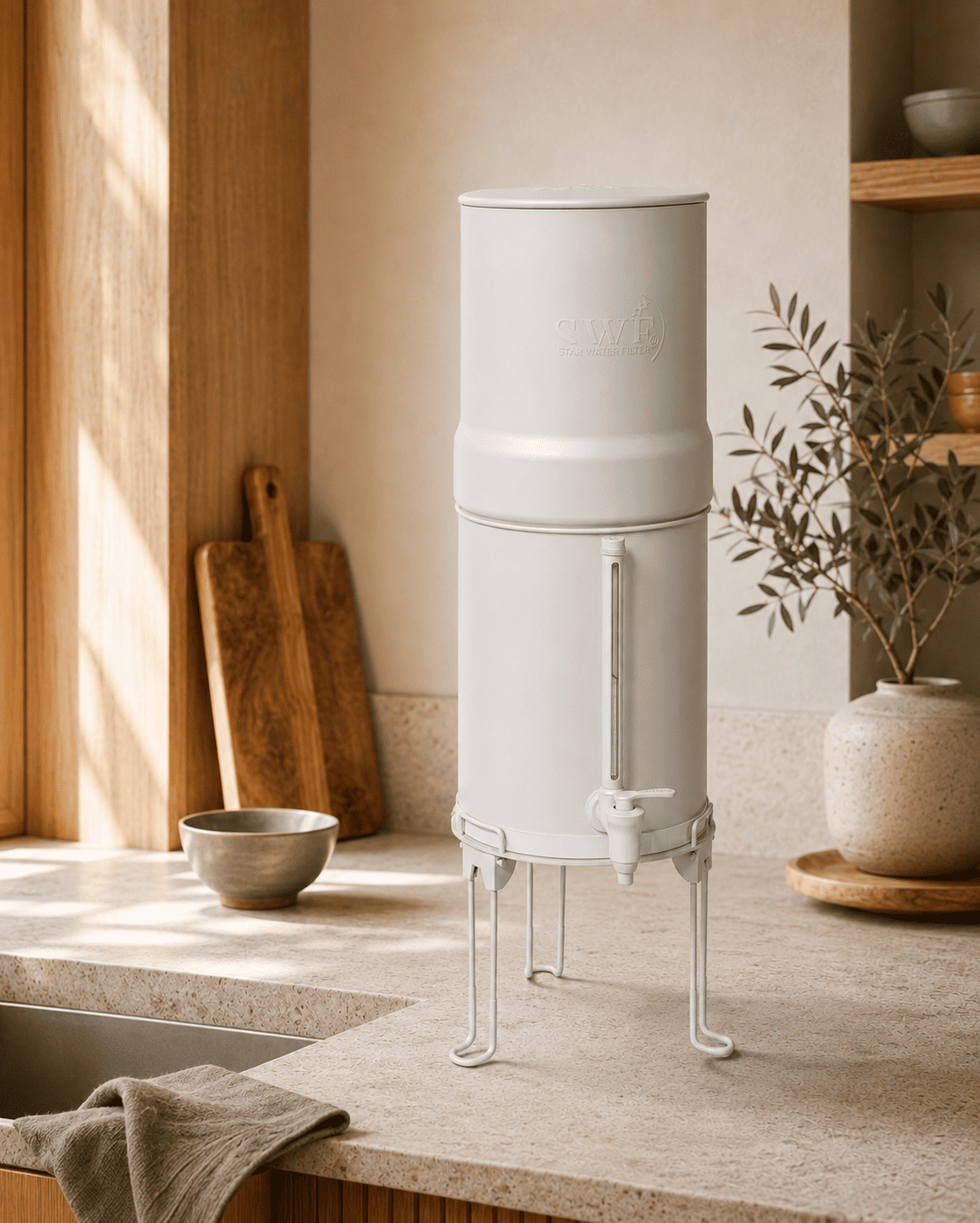
Matte cream Big Star® gravity-fed water filter on its stand in a contemporary kitchen

You want no installation work or plumbing connection

The system can be used as soon as it has been assembled and the cartridges have been primed and commissioned. It requires no modification to the kitchen and can be moved if you relocate or reorganise the space.

It is also suitable for homes where installing a fixed system is impossible or simply not desired.

You need a capacity suited to your household

Filtered water is stored in the lower chamber and remains available from the tap. Star Water Filter® systems offer capacities ranging from 5.6 to 12.3 L, allowing the reserve to be adapted to household size and daily use.

With two new USF cartridges, the typical flow rate of 12 to 16 L/h comfortably covers normal household requirements.

You want filtration without electricity or wastewater

Water passes naturally through the cartridges under its own weight. Operation does not rely on an electrical supply, pump or pressure from the water network.

Unlike reverse osmosis, none of the water poured into the system is discharged during filtration.

You require performance that can be verified over time

The principle of gravity alone does not guarantee a filter’s effectiveness. The difference lies in cartridge design and the quality of the published evidence.

Ultimate Star Filter® cartridges have been independently tested at several volume stages, with chemical performance monitored up to 3,200 L and microbiological performance up to 3,000 L, depending on the reports concerned.

The main constraint: filling remains manual and the chambers require periodic cleaning. Choosing a capacity suited to the household nevertheless reduces refill frequency and maintains comfortable everyday use.

Frequently asked questions

Frequently asked questions about choosing a water filtration system

The following answers summarise the main differences between filter jugs, tap-mounted filters, under-sink systems, reverse osmosis and gravity-fed filtration.

What is the best filtration system for tap water?

There is no single best system for every situation. The right choice depends on the contaminants targeted, the level of evidence required, daily volume, acceptable installation and budget. For a household seeking documented filtration, family-sized storage, no wastewater and operation without plumbing or electricity, a gravity-fed system equipped with cartridges whose performance can be verified offers a particularly comprehensive solution.

Filter jug or tap-mounted filter: which should you choose?

A filter jug is mainly suited to small volumes and requires frequent refilling and cartridge replacement. A tap-mounted filter provides filtered water on demand but must be compatible with the tap and depends on mains pressure. In both cases, compare the contaminants actually tested, the volume covered and the cartridge cost per litre filtered.

Reverse osmosis or gravity-fed filter: what are the differences?

Reverse osmosis uses a pressurised membrane and can reduce many dissolved substances. It requires a plumbing connection, produces wastewater and substantially reduces mineral content. A gravity-fed filter operates without mains pressure, electricity or wastewater during filtration. It stores filtered water in its lower chamber, but its effectiveness depends entirely on cartridge design and the supporting evidence available.

Does a water filter remove limescale?

Not necessarily. Water hardness is mainly related to calcium and magnesium. Many drinking-water filters reduce certain contaminants without significantly affecting hardness. When the main objective is to protect pipes and appliances from limescale, a water softener is generally more suitable, but it does not replace a filter designed to reduce micropollutants.

Which water filtration system preserves minerals?

Systems based mainly on activated carbon or certain selective filter media do not generally work through overall demineralisation. Reverse osmosis reduces dissolved substances more broadly, including a significant proportion of minerals. However, the precise effect on mineral composition must be verified for the product concerned through analyses conducted before and after filtration.

How can you tell whether a filter actually reduces PFAS or heavy metals?

Check that the specific PFAS or metal is named in a report covering the complete product. The laboratory, protocol, concentrations before and after filtration and tested volume should all be identifiable. A general reference to activated carbon or an “anti-PFAS” claim is not sufficient. You can review the independent test results for Ultimate Star Filter® cartridges.

Can rainwater, well water or water from an unknown source be filtered?

Prior testing is essential. Appearance, smell and taste cannot rule out chemical or microbiological risks. A household filter does not automatically make this water safe to drink: treatment must be determined from the test results and may require several complementary stages. Do not use microbiologically unsafe water or water of unknown quality without appropriate prior treatment.

Methodology and transparency Updated on

How was this comparison prepared?

This guide compares the main water filtration systems according to their typical operation, installation, autonomy, maintenance, running costs and the evidence available to assess their performance.

Publisher of the comparison Star Water Filter® team

Star Water Filter® designs and sells gravity-fed water filters. This commercial interest is openly acknowledged and has been taken into account when preparing this page. To preserve the usefulness of the comparison, we distinguish the general characteristics of a system category from the performance of individual products.

The information is cross-checked against available official sources, technical documentation, applicable standards and certifications, and accessible test reports. A technology is never considered effective against a specific contaminant without supporting results.

This comparison therefore does not identify a universally superior water filter. Its purpose is to help you determine which system best matches a particular need and then verify the performance of the product being considered before purchase.

Switch to gravity filtration

Discover Star Water Filter® gravity-fed water filters

If you are looking for an autonomous solution requiring no connection, electricity or wastewater production during filtration, discover Star Water Filter® systems. Several capacities and finishes are available to suit your household, daily needs and kitchen.

View Star Water Filter® systems