 Rating 5/5


Water filter comparison: why a rating alone isn’t enough
COMPARISON • RANKING • EVIDENCE • TEST PROTOCOLS
A score out of 10 or a podium gives the impression that the quality of a water filter can be summarised immediately. Yet behind that figure are always choices: which criteria were selected, how much importance was assigned to each one, and what evidence actually makes them verifiable?
To go beyond a simplified ranking, our technical comparison of gravity water filters distinguishes identified characteristics, published evidence, partial data and information that cannot be verified from publicly accessible sources.
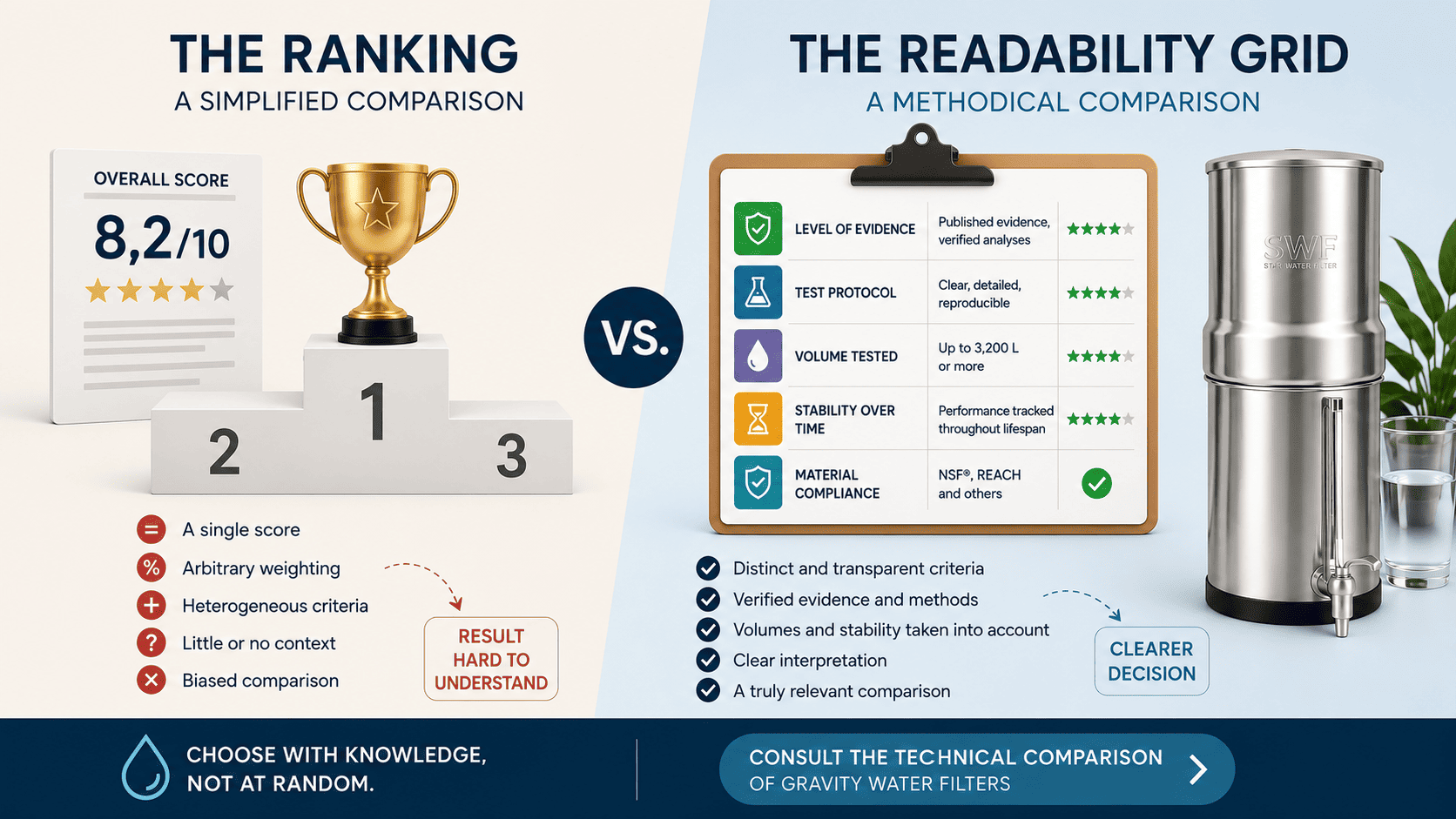
A ranking provides an order. A reading grid helps explain how that order was built.
Key points
- An overall score always depends on the criteria selected and how they are weighted.
- A certification, an independent analysis and manufacturer information do not answer the same question.
- Two accurate results are not necessarily comparable if their protocols or tested volumes differ.
- The absence of accessible evidence does not justify concluding that a filter is ineffective.
- For a serious choice, a documented reading grid is often more useful than a podium.
THE COMMON ASSUMPTION
A score may look objective, but it always rests on choices
A score out of 10 can be calculated precisely. That does not make it neutral. Even before the calculation begins, someone must decide what matters, how each criterion will be measured and how much weight it will carry in the final result.
Defining the criteria
Price, stated capacity, flow rate, architecture, certification, contaminants analysed or stability over time: the ranking already changes according to the criteria included or excluded.
Assigning a weight to each one
How many points should a certification be worth compared with an independent analysis? Should price count as much as performance stability? The answer depends on the method chosen.
Turning different data into a score
A lifespan expressed in litres, material compliance, an analysis result and a technical feature do not use the same unit or provide the same level of evidence. Adding them together requires explicit rules.
Deciding how to treat missing data
Should a zero be assigned when no public evidence can be found? Or should the criterion simply be marked as unverifiable? This decision can substantially alter a ranking.
A score can therefore be internally consistent without being universal. Two reviewers examining the same filters may produce different podiums simply because they do not give the same priority to the criteria.
METHODICAL READING
What a single score can hide
The issue is not the existence of a score in itself. The issue arises when the score replaces the explanation. To understand the true meaning of a ranking, the reader must be able to see what lies behind each criterion.
On mobile, scroll horizontally to view all columns.
| Displayed information | Quick reading | What it still does not tell you | Useful question to ask |
|---|---|---|---|
| Overall score | One system appears to rank higher than another. | The criteria selected, their weighting and how missing data were treated. | How was the score calculated? |
| Stated lifespan | The filter appears usable for a high number of litres. | The volume up to which performance was actually analysed. | Were results tracked close to the stated end of life? |
| Reduction percentage | The performance immediately appears high. | The contaminant, concentration, pH, flow rate, volume and stage of the test. | Under what conditions was this result obtained? |
| NSF® reference | A recognised framework is associated with the product or one of its components. | The relevant standard, the exact scope and what is actually certified. | Does the reference apply to the finished product, a component or a test protocol? |
| Information not found | The criterion appears absent or insufficiently documented. | The filter may still perform even if the evidence is not publicly accessible. | Can the performance be verified from an available document? |
A serious reading does not simply look for the highest figure. It seeks to understand what was measured, how, at what volume and with what level of documentation.
DO NOT CONFUSE
Certification, independent analysis and manufacturer information do not answer the same question
All three sources of information can be useful. However, they are complementary rather than interchangeable. Combining them in a score without explaining their scope can create an impression of scientific comparison even though the evidence is not of the same nature.
Published independent analysis
It measures performance under defined conditions: contaminant, concentration, analytical method, filtered volume and measurement point. Its value depends on how clearly the protocol and report can be read.
→ An exploitable measurement when placed in context
Certification or compliance
An NSF® certification provides a recognised framework within a defined scope. Compliance such as REACH relates in particular to substances and materials. Neither replaces a detailed performance analysis.
→ A strong reference point to be interpreted within its exact scope
Manufacturer information
A technical data sheet or product page may describe the architecture, stated lifespan or claimed performance. This information becomes stronger when it links to independent, verifiable documents.
→ Useful information whose scope depends on the supporting evidence
To view the documents available for the Ultimate Star Filter®, see the laboratory test results. The point is not to systematically oppose certification and analysis, but to understand what each one can actually establish.
COMPARING RESULTS
Two accurate results are not necessarily directly comparable
Two filters may display similar percentages from genuine analyses while having been assessed under different conditions. Both results may be accurate on their own without answering the same question.
The contaminant tested
Comparing different contaminant families, or one molecule with a much broader group, can create a misleading impression of equivalence.
The protocol conditions
Initial concentration, pH, flow rate, water quality and analytical method all influence the meaning of a result. These factors are explained in our article on the test protocol used to assess a water filter.
The volume already filtered
A measurement taken at start-up and another obtained after several thousand litres may both be valid, but they do not assess the same level of stability.
The scope actually documented
A test may track one contaminant up to a high volume without proving that every other performance remains unchanged over the same lifespan.
A result therefore only has meaning when accompanied by its conditions. Comparing percentages alone means comparing the conclusions without checking the questions the tests were designed to answer.
AN ESSENTIAL DISTINCTION
“No accessible evidence” does not mean “ineffective filter”
When a comparison cannot find a public report that verifies a criterion, two very different conclusions are possible. The first is methodologically cautious. The second goes too far.
The performance is not publicly verifiable
At the date of the study, no clear, accessible data made it possible to verify the criterion concerned. The level of documentation is therefore limited.
The filter does not work
This claim cannot be inferred from the absence of a public document alone. A lack of accessible evidence is not evidence of a lack of performance.
Do not assign an artificial zero
A zero score turns a documentary limitation into a technical judgement. It may distort the ranking if the method does not distinguish between these two issues.
State precisely what is missing
Full report, protocol, volume, contaminant or certification: specifying the nature of the missing information is more useful to the consumer than a blanket penalty.
This is why our comparison uses distinct labels such as “published evidence”, “partial evidence” and “no accessible evidence”. They describe the level of documentation identified, not an absolute score for the quality of a filter.
FILTER LIFESPAN
Stated litres must be compared with the volumes actually tested
A stated capacity indicates the period of use intended by the brand. On its own, it does not show how far each performance has been measured. To read this figure seriously, three situations should be distinguished.
Monitoring close to end of life
Analyses are carried out at several stages and reach a volume close to, equal to or sometimes greater than the nominal lifespan. Stability then becomes directly observable for the criterion tested.
Partial monitoring
Some contaminants are measured at high volumes, while others are only tested at start-up or at intermediate stages. Evidence exists, but its scope must be specified.
Mainly theoretical capacity
A high lifespan is stated, but no public analysis tracks performance up to the claimed volume. Capacity should not then be confused with demonstrated stability.
Lifespan indicates how long the filter is intended to be used. Documented stability indicates how far its performance has actually been monitored. To explore this subject further, read our article on the real lifespan of a gravity water filter.
WHAT TO LOOK AT
A reading grid is more useful than a podium
A good grid does not try to eliminate every conclusion. It makes visible the reasons that support it. Before choosing a gravity water filter, six questions provide a particularly useful structure for comparison.
Is the architecture explained?
Activated carbon, ceramic, membrane, heavy-metal media or bacteriostatic treatment: knowing the components helps explain the mechanisms being claimed.
Are the analyses accessible?
The reader should be able to identify the laboratory, contaminants, results and, ideally, the full reports.
Are the protocols and volumes clear?
Performance becomes more valuable when it can be placed within a specific method, set of conditions and filtered volume.
Is stability monitored over time?
Measurements taken at several stages help distinguish initial performance from performance actually observed during use.
Is the nature of the certification specified?
It is important to distinguish certification of a finished product, certification of a component, testing according to a standard and compliance relating to materials.
Are the limitations clearly stated?
Serious documentation also explains what has not been tested, what remains partial and what cannot be directly compared.
This method reflects the criteria set out in our guide: how to know whether a water filter is genuinely effective.
OUR METHOD
Why our comparison is not reduced to one winner and a score out of 10
Our comparison applies the same reading grid to eleven gravity filtration systems. Its purpose is not to create an artificial podium, but to show what can genuinely be understood from the information publicly accessible at the date of the study.
Architecture and design
The comparison identifies the filtration media, complementary technologies and level of detail available beyond the main material.
Analyses and protocols
It distinguishes published reports, readable volumes, normative references and data whose scope remains incomplete.
Stability over time
The stated lifespan is compared with the volumes actually tested, contaminant by contaminant whenever the information allows.
Certification and compliance
The exact nature of NSF® references and material-related documents is separated from performance results.
The result is a more nuanced reading: published evidence, partial evidence, claim to be verified or no publicly accessible evidence. This method does not remove the decision; it allows the decision to be based on more transparent information.
FREQUENTLY ASKED QUESTIONS
Water filter rankings, scores and comparisons: the questions to ask
Is a score out of 10 necessarily misleading?
No. A score can be useful if the criteria, sources, calculation rules and weightings are clearly explained. It becomes problematic when it creates an impression of objectivity without showing how it was constructed.
Why can two comparisons produce different rankings?
Because they do not necessarily use the same criteria or assign them the same weight. One may prioritise price and stated capacity, while another places greater importance on analyses, protocols and stability over time.
Is NSF® certification enough to rank a filter?
No. NSF® certification is an important reference point, but the relevant standard and exactly what has been certified must be identified. It should be read together with the filter architecture, published analyses and other documentation.
Can two reduction percentages be compared directly?
Only if the conditions are sufficiently similar and clearly documented: the same contaminant, comparable concentrations, an identifiable protocol, filtered volume and stage of the filter lifespan. Otherwise, the results may both be accurate without being directly comparable.
What does “partial evidence” mean in a comparison?
It means that data exist but their scope is limited: low tested volume, incomplete protocol, results available only for certain contaminants or documentation that cannot be clearly interpreted up to the stated lifespan.
Does “no accessible evidence” mean that the filter does not work?
No. It means that no clear public data were identified to verify the criterion at the date of the analysis. The label describes the level of documentation, not evidence of ineffectiveness.
Why is the tested volume as important as the stated lifespan?
Because a filter may perform very well at start-up without that performance having been monitored through to the end of its life. The tested volume shows precisely when the result was measured.
What is the best way to use a water filter comparison?
Start by examining the method, then identify the criteria most important for your needs. The table should serve as a starting point towards reports, certifications, technical explanations and documentary limitations.
CONCLUSION
A ranking provides a quick answer. A method helps explain that answer.
A score or podium can make an initial reading easier, but it should never replace examination of the criteria that produced it. In water filtration, the data are too different to be added together without explanation: architecture, certification, compliance, analyses, protocols, tested volumes and stability over time do not tell the same story.
The most useful comparison is therefore not necessarily the one that immediately names a winner. It is the one that shows what is documented, what remains partial and what cannot be verified from the available information.
What to remember
Before asking which filter ranks first, ask how the ranking was built and what evidence makes each criterion verifiable.
A podium provides an order. A reading grid provides the reasons.
Go further
Gravity water filter comparison
Water filter test protocol
Understand why the contaminant, pH, flow rate, concentration and volume influence the results.
Gravity filter lifespan
Distinguish stated litres from volumes actually documented through testing.
Laboratory test results
View the independent analyses published for the Ultimate Star Filter®.
NSF® certification
Understand the scope of NSF® certification and how to interpret it.
REACH and material compliance
Understand why material compliance complements performance evidence without replacing it.

Star Water Filter®
The technical content published on this website is written and validated by the Star Water Filter® technical team.
It is based on independent laboratory analyses, performance data from the Ultimate Star Filter® and experience gained in the design and use of gravity filtration systems.


